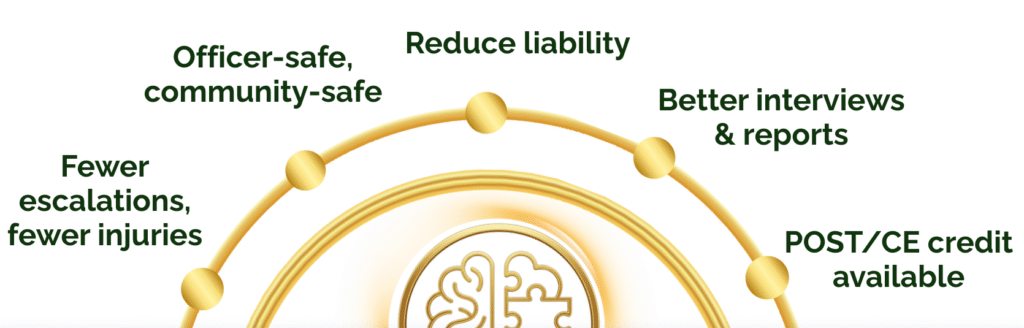
Give your officers the skills to recognize individuals with autism, reduce risk, and resolve calls safely — on traffic stops, at homes and schools, during critical incidents, and especially when a missing individual may be drawn to water.
Why Agencies
Ch
se
Autis
ul
built for real
p
lice
w
rk
Designed for patrol officers, school resource officers, dispatch/call-takers, corrections, and supervisors. Scenario-driven, easy to remember under stress, and immediately usable on the next shift.
What
Y
ur
Team
Will
Walk
Away
Able
What
t
d
Recognize stress signs in an individual with autism (which can be mistaken for defiance or intoxication).
Communicate clearly with plain language, extra processing time, and visual/alternative options.
De-escalate by adjusting environment, spacing, and touch; using one-step directions and tactical pauses.
Differentiate a meltdown from criminal behavior and makesafer, well-documented decisions.
Coordinate with caregivers, schools (IEP/504), mobile crisis, and community partners forsafe outcomes.
Critical Water Safety:
Fast
Acti
N
Saves Lives
Many individuals with autism are naturally drawn to water and can drown very quickly. AutiSoul training prepares your team to:
Adopt a water-first mindset
Immediately check ponds, streams, retention basins, pools, fountains, culverts, drainage ditches, and other waterfront points.
Ask the right questions early
Gather history of water-seeking behavior, favorite locations, prior incidents, or known routes.
Search smart and safely
Assign officers strategically, use drones or air support,
and request fire/EMS water-rescue assets immediately.
Use safe rescue practices
Follow “reach/throw/row — don’t go” unless trained and equipped for water entry.
Plan for reunification and medical care
Prioritize medical evaluation and calm, sensory-aware reunification.
Prevent future incidents
Provide families with local water-safety resources, barriers, and return-home registration; document water-risk notes.
Supervisor Tip: Build a quick-reference map of local water hazards and pre-plan dispatch prompts for automatic first- minute response.
Distinguish misconduct from a meltdown, partner with staff, and ensure safe re-entry.
Missing or Vulnerable Individuals
Rapid risk triage with a water-first search and respectful reunification.
Calls to a Residence
Calm the environment, prevent elopement, and support the individual with autism.
Suspected Abuse or Exploitation
Recognize indicators, avoid evidence contamination, and connect to specialized services.
Dispatch & Custody
Flag autism indicators for responding units, making transport and booking safer and more predictable.
What’s Included in Training
Pocket cardwith do/don’t steps for encounters with an individual with autism.
Water-risk checklistwith first-minute actions and local hazard prompts.
Visual communication aidsand plain-language phrase bank.
Report language templates for documenting accommodations and decisions.
Pr
ven,
Respectful,
and
C
mmunity
-
Inf
rmed
Our curriculum is co-developed with individuals with autism, caregivers, clinicians, and veteran officers. It is neurodiversity-affirming, trauma-informed, and focused on dignity and safetyfor
“Our use-of-force
complaints dropped,
and officers feel more
confident — especially
on missing-person
calls involving an
individual with autism
and nearby water.”
-Mia, A Parent
start the
j
urney
with us
Whether you’re celebrating your toddler’s first words or helping your teen prepare for college, Autisoul, is here to guide the way.